Inspection processes and rules for MOT tests on motorcycles and other class 1 and 2 vehicles.
Introduction
Introduction to the Inspection Manual
Definitions, vehicle classes, reasons to refuse to test a vehicle, historic vehicles, and inspection procedures for motorcycle MOT tests.
1. Abbreviations and definitions
| Abbreviation or term |
Definition |
| abandon |
When a test cannot be completed because the tester considers it unsafe to continue or because it becomes apparent during the test that certain items cannot be satisfactorily inspected. An appropriate fee may be charged for the test. |
| abort |
When a test cannot be completed because of a problem with the test equipment or the tester. No fee may be charged for the test. |
| AE |
Authorised Examiner – the organisation that operates and manages one or more VTS and is responsible for controlling the quality of testing carried out. The AE is not a person but a legal entity, such as a company or partnership, except in the case of a ‘sole trader’. |
| category L1 vehicle |
Two-wheeled moped with a maximum speed up to 45km/h, internal combustion engine up to 50cc or electric motor up to 4kW maximum continuous rated power |
| category L3 vehicle |
Solo motorcycle with an internal combustion engine over 50cc and/or a maximum speed over 45km/h |
| category L4 vehicle |
Motorcycle and sidecar with an internal combustion engine over 50cc and/or a maximum speed over 45km/h |
| CT |
Contingency testing – the test process using paper documentation when the online MOT testing service is not available |
| CT20 |
An MOT test certificate issued during a period of contingency testing. |
| CT30 |
A refusal of an MOT test certificate issued during a period of contingency testing. |
| DVSA |
Driver and Vehicle Standards Agency |
| MOT Testing Guide |
A handbook for MOT scheme administration available at https://www.gov.uk/topic/mot/manuals |
| MOT testing service |
Internet based system for registering MOT tests, producing MOT documentation and performing certain administrative functions |
| special notice |
An official notice issued by DVSA to inform AEs, testers and other system users of changes and developments to the testing scheme, and to highlight concerns |
| test |
All statutory tests recorded on the MTS database, regardless of whether the test is a full test or a retest. Further information on retests is provided in Section 17 of this Introduction |
| VT20 |
An MOT test certificate which includes the Welsh language version (VT20W) |
| VT30 |
A notice of refusal of an MOT test certificate including the Welsh counterpart (VT30W) |
| VTS |
Vehicle Testing Station |
| V5/V5C |
Vehicle registration certificate issued by the Driver and Vehicle Licensing Agency |
| you |
MOT tester |
2. Application (Classes 1 and 2)
This manual is a detailed guide to the inspection for statutory MOT testing of the following classes:
- Class 1 - motorcycles or motorcycle combinations up to 200cc and motorcycles with not more than 4kW maximum continuous rated power and a maximum design speed up to 45km/h (28mph) - Category L1, L3 and L4
- Class 2 - all motorcycles or motorcycle combinations other than those in category L1
A motorcycle combination has at least one wheeled element that’s clearly a sidecar. It’s acceptable if changes have been made to a solo motorcycle’s components such as brakes, tyres and suspension when it’s been adapted for use with a sidecar.
Other than for the inspection of tyres, any two wheels of a motorcycle shall be regarded as one wheel if the distance between the centres of the areas of contact between the wheels and the road surface is less than 460mm.
You should be aware that this may affect the test class, for example a three-wheeled vehicle with a wheel layout of 460mm or more must be tested as a tricycle (Class 3)
3. Motorcycles of historical interest (over 40 years old)
Some motorcycles of historical interest may be exempt from Statutory MOT testing. Such motorcycles must be over 40 years old and not substantially changed.
Owners of these motorcycles may still request a statutory test be conducted. In these circumstances, the test must be registered on the MOT testing service and carried out in the usual way, with the necessary documentation issued as appropriate.
Some historic motorcycles’ components may have been manufactured to have a greater degree of play or tolerance than in modern motorcycles.
4. Refusal to test
Legislation permits testers to refuse to test motorcycles in certain circumstances. If any of the reasons for refusal (see below) apply, you should not carry out the test and must return any fee paid for the test. You should carry out appropriate pre-checks before starting the test, to ensure the suitability and general condition of the motorcycle.
If the motorcycle presenter needs written confirmation of why the test cannot be carried out, you should register the test using the MOT testing service and issue a VT30 clearly showing the reason(s) why the test could not be carried out.
If the reason for refusal ‘i’ applies, you should issue a handwritten CT30 and include as many of the motorcycle details as possible. A copy of the CT30 should be retained by the VTS.
The reasons for refusing to carry out the test are:
- a. The log book / registration certificate or other evidence of the date of first use is not shown. Normally this evidence is only necessary if the motorcycle has a ‘cherished’ registration mark (also referred to as personalised registration number) or if the registration mark’s year letter does not make clear the standard that should be applied.
- b. The motorcycle or any part or equipment on the vehicle is so dirty that examination is unreasonably difficult.
- c. The motorcycle is not fit to be driven when necessary to complete the test because of a lack of fuel, or oil, or for any other reason.
- d. The tester considers a load or other items, or insecurity of a load or other items, would prevent a proper test being carried out – unless the load is secured or removed.
- e. The VTS asks for the fee to be paid in advance and this is not done.
- f. The motorcycle emits substantial quantities of avoidable smoke.
- g. A proper examination cannot be carried out because any cover, fuel cap or other device designed to be easily opened cannot be easily opened.
- h. The condition of the motorcycle is such that, in the opinion of the tester, a proper examination would involve a danger of injury to any person or damage to the motorcycle or other property.
- i. The motorcycle does not have a registration mark or VIN, chassis number, frame number by which it can be identified, or that all such identifications are illegible or use letters and numbers not normally used in the English language.
If despite due care initially, it becomes apparent during a test that the test cannot be completed for any of the above reasons, the test must be abandoned, or the motorcycle failed because the test could not be satisfactorily completed. Any subsequent re-examination and fee must be in line with normal policy. See the MOT fees and appeals poster (VT9A) for further information.
In addition to the above reasons, you must decline to test any motorcycle that:
- is not of a class you are authorised to test
- is of such a size, weight or configuration it cannot be properly or safely tested on the approved facilities
- requires a road test or decelerometer test and is of such a size it cannot legally be ridden by a tester with a restricted driving licence
- requires a road test or decelerometer test and is of such a size or configuration that the tester cannot safely ride the machine
- has the frame stamped with ‘not for road use’ or similar words
5. Motorcycle ‘first used’ dates - application of test criteria
Usually you’ll be given the details of the motorcycle as part of the registration process. This will usually include the motorcycle’s ‘first used’ date. If this information is available, you should only use defects appropriate for the motorcycle’s age.
When the ‘first used’ date is not known or incorrect, you should determine the motorcycle’s ‘first used’ date as follows:
- a. Its date of manufacture, if the motorcycle was originally used without being registered in GB, such as an imported motorcycle or ex-HM Forces motorcycle.
- b. Motorcycles with a Q plate registration when presented for MOT are to be treated as being first used on 1 January 1971.
- c. In any other case, the earlier of either its date of first registration or the date six months after it was manufactured. For example, motorcycles first used on or after 1 April 1986 must have stop lamps that are operated from both brake controls, but a motorcycle first used after that date, but manufactured at least 6 months before (1 October 1985) that date would not need to comply with this requirement.
This information should be entered onto the MOT testing service to let the tester select the appropriate defects.
6. The inspection manual
Although this manual is publicly available, it’s specifically written for MOT testers. It specifies the applications, procedures and standards to be used for motorcycle MOT testing. You must read it with any current special notices relevant to the class or type of motorcycle under test.
You should familiarise yourself with the contents of the manual and any amendments to it, including special notices which affect test procedures or standards.
The manual numbering system follows that of the European Roadworthiness Directive. Some Directive items do not apply to motorcycles, which is why there are gaps in the numbering.
Defects found during the MOT test must be categorised in one of the following groups:
- minor - defects having no significant effect on the safety of the motorcycle or impact on the environment and other minor non-compliances
- major - defects that may prejudice the safety of the motorcycle, have an impact on the environment, put other road users at risk or other more significant non-compliances
- dangerous - defects constituting a direct and immediate risk to road safety or having an impact on the environment
If a motorcycle has only minor defects, it will pass its MOT inspection and a test certificate will be issued. If a motorcycle has any major or dangerous defects, it must be failed and a refusal notice issued.
7. Motorcycle technical data
The MOT testing service may give testers technical information about certain motorcycles under test. This is to help testers choose the correct test methods and/or apply the correct standards.
8. The MOT testing guide
The MOT testing guide explains what is required of persons and organisations authorised to conduct statutory tests on motorcycles. It also includes, amongst other things, information on the administration of the MOT scheme, disciplinary procedures and equipment calibration requirements.
9. Assessment of component condition
It is not practicable to lay down limits of wear and tolerances for all types of components on different models of motorcycle, or to define acceptable amounts of damage, deterioration and effectiveness. You are therefore expected to use your knowledge, experience and judgement to assessing if the condition of a component has reached the stage where it’s obviously adversely affecting its functionality or likely to adversely affect the roadworthiness of the motorcycle.
10. Definition of insecure
The term ‘insecure’ is used many times throughout this manual to describe a defective condition. This term should be taken to mean one of the following:
- a component has relative movement (looseness) at its fixings where there should be none
- a component has relative movement (looseness) to an associated component where there should be none
- a safety critical component (braking, steering or suspension system component) is not safely or completely attached at its fixing or to an associated component
In determining whether a component in a safety critical system is safely attached, consideration must be given to the function of the component and the overall number of securing devices. For example:
- a missing brake pipe clip does not necessarily mean the brake pipe is insecure if the brake pipe remains adequately supported
- a suspension bracket with one of many securing bolts loose does not necessarily mean the bracket is insecure if it remains adequately secured with no signs of visible movement
Wheel security has specific criteria detailed in the manual.
11. Unsafe modification
Modifications to motorcycles must be assessed on their merits, taking account of the nature of the modification and whether the component is safety critical.
The main criteria to be used are whether the modification adversely affects the roadworthiness of the motorcycle, or it’s likely to cause injury.
12. Inspection procedure
You are advised to carry out pre-checks to ensure the general condition and suitability of the motorcycle for test. Other than when using a contingency test (CT) code, a test must not commence until you have registered the motorcycle for test in the MOT testing service (see MOT testing guide).
When registering a motorcycle for test, the actual details from the motorcycle must be used. It is not acceptable to use details from other sources such as the V5C, job card or previous electronic record.
The tester who registered the motorcycle for test must personally carry out the test, without avoidable distraction or interruption and only the tester is empowered to make decisions about the test results. The tester must use a suitable assistant for certain parts of the inspection.
If you or your assistant are not familiar with the controls of the motorcycle, you should ask the vehicle presenter - if available - to operate or demonstrate the controls.
Small tools, such as pinch bars, levers and the corrosion assessment tool must be used when necessary. A hand held inspection mirror may be used in the inspection but it is not mandatory.
The MOT test must be carried out without dismantling, so it is not always possible to inspect some testable items. Access panels, covers and seats designed to be easily removed or opened without tools must be removed or opened when necessary, so that the testable items can be inspected. You must abandon or refuse to carry out the test if it is not possible to test an item because an access panel, cover or a seat does not open despite having been designed to be easily opened.
Solo machines without a centre-stand should be jacked to raise the wheels clear of the ground to check steering and suspension. It is not recommended to pull a machine over on the side-stand.
Once the inspection is completed, you must record the test results in the MOT testing service (see MOT testing guide).
If testing under CT, you must calculate brake efficiencies and retain the readings for later data entry. You should record all results on the VT29 and retain any printout. Refer to the MOT testing guide for a full explanation of CT procedures.
Recommended inspection routine
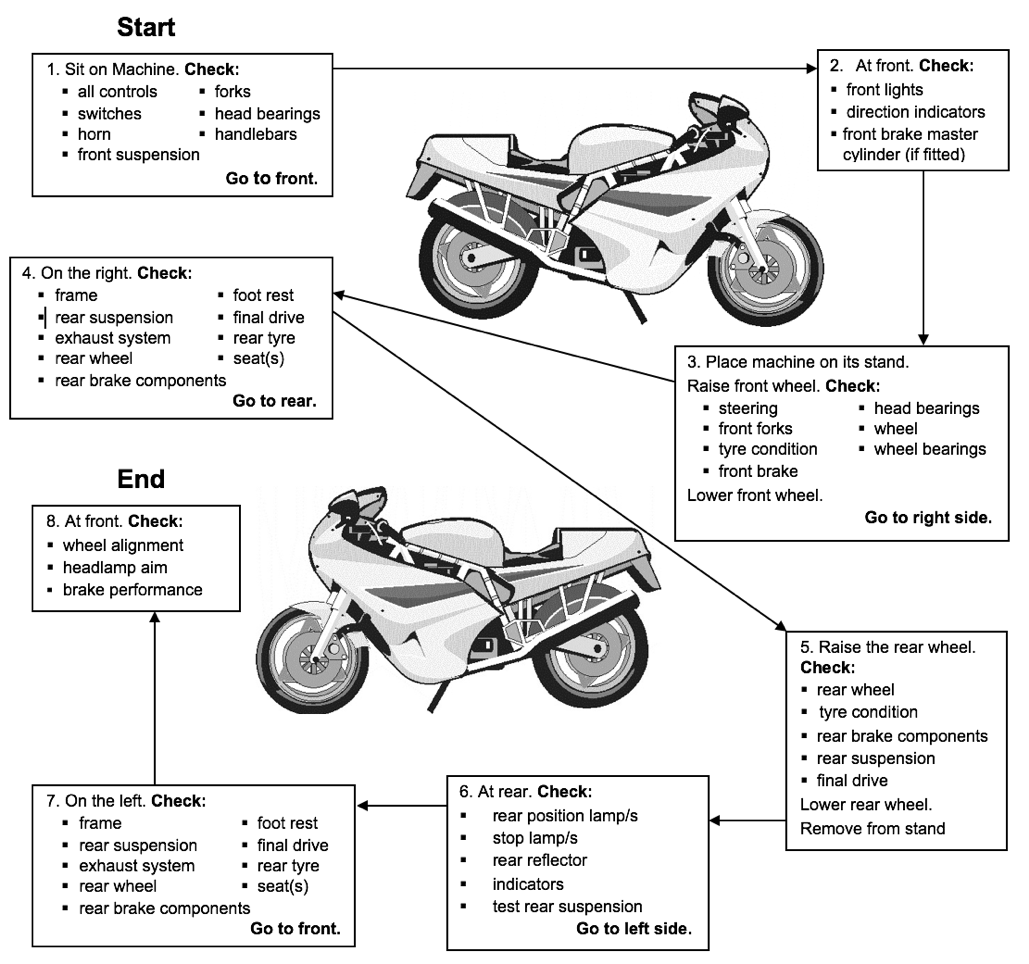
Diagram 1 shows a DVSA recommended inspection routine for a motorcycle. The routine may need to be varied to suit different test bay layouts and equipment types. It’s recommended that the brake performance test is not carried out until after the rest of the inspection to prevent an unknown defect causing injury to a person, damage to the motorcycle or other property.
Before starting the inspection, check reasons to refuse/decline to test items.
It may be necessary to use an assistant for certain checks. It’s therefore advisable that an assistant remains with the tester for the whole duration of the test.
Diagram 1. Recommended inspection routine
13. Road testing
The statutory test does not specifically include a road test of the motorcycle. However, one is permitted if you think it’s necessary to check the results of an inspection. You must have an appropriate licence to ride the motorcycle and make sure the motorcycle is in a safe condition to conduct the road test.
14. Disabled rider’s controls
If a disabled rider’s control or fitment is additional to the standard rider’s controls (such as a thumb operated brake) and does not adversely affect the standard motorcycle equipment, it does not need to be tested. However, if any such equipment is defective, it should be reported to the vehicle presenter.
Disabled motorcycle controls or fitments that replace or affect the standard controls should be tested in the normal way and any defects recorded as usual.
15. Health and safety
AEs and their staff must adhere to all relevant health and safety legislation while MOT testing. You can find out more from your local health and safety enforcement officer or local authority environmental health officers.
16. Recording defects
Defects covered in this manual are selected from a component-based menu system in the MOT testing service. You will first select the appropriate component from the main component list and then make further selections from the sub-menu(s). Once you’ve selected the appropriate component, a list of defects will be available for selection.
Various defect categories may be available for the same item depending on the nature or severity of the defect – minor, major or dangerous. You must select the appropriate category, guided by the defect wording, and use your knowledge, experience and judgement.
When an item is not sufficiently deteriorated to justify rejection, there may be an option to select ‘advisory’ to inform the presenter of this fact.
When only minor defects have been selected, a test certificate will still be issued. Unlike advisory items, the use of minor defects, where appropriate, is mandatory.
If you think that a defect on a non-testable item is dangerous, you should explain it to the motorcycle presenter.
Some defects listed in the inspection manual may not be accessible if they are not relevant due to the age of the motorcycle. However, advisory items (if appropriate) for these defects may still be selectable.
It is considered best practice to advise the vehicle presenter of:
- any items which are near to, but which have not yet reached the point of test failure
- any peculiarities of the vehicle identified during the inspection
- any defects on non-testable items which are found during the inspection
17. Retest following failure
Information on retest fees and procedures can be found in the current MOT testing guide and on the ‘MOT fees and appeals’ poster (VT9A).
When carrying out a partial retest you must:
- examine all the previously failed item(s)
- examine item(s) that may have been affected by repairs
- carry out another brake performance test and record the results in the MOT testing service, where the braking system may have been affected by the repairs
- examine any minor defect or item advised on at the time of the initial test
If during a retest it’s clear that the motorcycle has any major or dangerous defects, you must issue a new VT30.
18. Testing electric and hybrid motorcycles
You should be careful when testing electric and hybrid motorcycles, because they have many high voltage components such as storage capacitors and batteries. A hybrid motorcycle’s engine may start without warning if electrical equipment is operated or if the battery voltage drops.
Guidance for MOT testers testing hybrid, electric and hydrogen fuel cell systems.
Brake condition and operation (including brake lever and pedal, lining and pads, callipers and cylinders), brake performance and efficiency, and brake fluid rules and inspection for motorcycle MOT tests.
1.1. Condition and operation
1.1.1. Brake lever and pedal pivot in use
| Defect reference |
Defect description |
Category |
| (a) |
Lever or pedal pivot too tight |
Major |
| (b) |
Lever or pedal pivot has excessive wear or free play |
Major |
1.1.2. Brake lever and pedal condition and travel
A motorcycle must only be failed for insufficient reserve travel if the brake lever is touching the handlebar or the brake pedal is fouling another part of the motorcycle. Motorcycles with servo-assisted braking systems should be checked with the engine running.
On some motorcycles it may be possible to pull the brake lever back until it touches the handlebar. In such cases the extent of reserve travel should be assessed during the brake test.
A brake pedal should be failed if its grooves or raised sections are worn smooth. However, a brake pedal should not be failed if the motorcycle has been manufactured with one that does not have grooves or is fitted with anti-slip material.
Where a brake pedal rubber is fitted, this is considered an anti-slip material. It’s therefore not regarded as a defect if the design pattern is worn smooth.
| Defect reference |
Defect description |
Category |
| (a) |
Brake control has insufficient reserve travel |
Major |
| (b)(i) |
Brake control not releasing correctly |
Minor |
| (b) (ii) |
Brake control not releasing correctly so that the functionality of brakes affected |
Major |
| (c) |
Brake pedal anti-slip provision missing, loose or worn smooth |
Major |
| (d) |
Brake control so positioned, bent or shortened that the brake cannot be readily applied |
Major |
| (e)(i) |
Brake control insecure |
Major |
| (e)(ii) |
Brake control so insecure that the brake cannot be readily applied |
Dangerous |
1.1.3. Not in use
1.1.4. Not in use
1.1.5. Not in use
1.1.6. Not in use
1.1.7. Not in use
1.1.8. Not in use
1.1.9. Not in use
1.1.10. Brake master cylinder and servo
To check the operation of the brake servo:
-
Apply the brake control with the ignition off.
-
With the brake still applied, turn the ignition on.
-
The inspection is successful when you feel that the brake control increases brake pressure without any increase in effort.
Hydraulic brake fluid level checks are confined to transparent reservoirs or where an indicator is fitted. Reservoir caps should not be removed.
| Defect reference |
Defect |
Category |
| (a)(i) |
Brake servo defective or ineffective |
Major |
| (a)(ii) |
Brake servo inoperative |
Dangerous |
| (b)(i) |
Master cylinder defective but brake still operating |
Major |
| (b)(ii) |
Master cylinder leaking |
Dangerous |
| (c) |
Master cylinder insecure |
Major |
| (d)(i) |
Brake fluid below minimum mark |
Minor |
| (d)(ii) |
Brake fluid significantly below minimum mark |
Major |
| (d)(iii) |
Brake fluid not visible |
Dangerous |
| (e) |
Master cylinder reservoir cap missing |
Major |
1.1.11. Rigid brake pipes
If the corroded metal brake pipes have surface dirt that needs to be removed before it’s possible to assess their condition, it’s permissible to lightly scrape the pipe with a specialist brake pipe corrosion tool or the corrosion assessment tool ‘spade end’. It must be done with care so that any protective coating does not get damaged.
Chafing, corrosion or damage to a rigid brake pipe so that its wall thickness is reduced by 1/3 (approximately 0.25mm for typical hydraulic brake pipe) justifies rejection, although it’s accepted that this is not easy to determine. The wall of a typical hydraulic brake pipe is around 0.75mm thick. If you are not sure whether the pipe is sufficiently deteriorated to justify rejection, you should give the benefit of the doubt.
| Defect reference |
Defect description |
Category |
| (a) |
Brake pipe is at imminent risk of failure or fracture |
Dangerous |
| (b) |
Leaking brake pipe or connection |
Dangerous |
| (c) |
Brake pipe excessively damaged or excessively corroded |
Major |
| (d)(i) |
Brake pipe inadequately clipped or supported |
Minor |
| (d)(ii) |
Brake pipe likely to become detached or damaged |
Major |
1.1.12. Flexible brake hoses
A hose should only be considered excessively damaged or chafed if it’s severe enough to expose the reinforcement.
| Defect reference |
Defect description |
Category |
| (a) |
Brake hose damaged and likely to fail |
Dangerous |
| (b)(i) |
Flexible brake hose slightly damaged, chafed or twisted |
Minor |
| (b)(ii) |
Flexible brake hose excessively damaged, deteriorated, chafed, twisted or stretched |
Major |
| (c) |
Brake hoses or connections leaking |
Dangerous |
| (d) |
Brake hose bulging under pressure |
Major |
| (e) |
Brake hose porous |
Major |
| (f)(i) |
Brake hose ferrules excessively corroded |
Major |
| (f)(ii) |
Brake hose ferrules excessively corroded and likely to fail |
Dangerous |
1.1.13. Brake linings and pads
| Defect reference |
Defect description |
Category |
| (a) |
Brake lining or pad worn below 1.0mm |
Dangerous |
| (b) |
Brake lining or pad contaminated with oil, grease etc. |
Major |
| (c) |
Brake lining or pad missing or incorrectly mounted |
Dangerous |
1.1.14. Brake discs and drums
A brake disc or drum must be significantly worn before rejection is justified. Being worn below the manufacturer’s recommended limit is not a reason in itself.
| Defect reference |
Defect description |
Category |
| (a)(i) |
Brake disc or drum significantly and obviously worn |
Major |
| (a)(ii) |
Brake disc or drum insecure, fractured or otherwise likely to fail |
Dangerous |
| (b) |
Contaminated with oil, grease etc. |
Major |
| (c) |
Missing |
Dangerous |
| (d) |
Brake drum back plate insecure |
Major |
1.1.15. Brake cables, rods, levers and linkages
A component such as a brake rod should be considered to be excessively worn or corroded if its diameter is reduced by more than a third.
| Defect reference |
Defect description |
Category |
| (a) |
Cable damaged or knotted |
Major |
| (b) |
Component excessively worn or corroded |
Major |
| (c) |
Cable, rod or joint insecure |
Major |
| (d) |
Cable guide defective affecting operation |
Major |
| (e) |
Restriction in free movement of the braking system |
Major |
| (f) |
Abnormal movement of levers indicating maladjustment or excessive wear |
Major |
1.1.16. Brake callipers and cylinders
| Defect reference |
Defect description |
Category |
| (a)(i) |
Brake calliper or cylinder cracked or damaged and braking performance not affected |
Major |
| (a)(ii) |
Brake calliper or cylinder cracked or damaged and braking performance affected |
Dangerous |
| (b)(i) |
Brake calliper or cylinder leaking and braking performance not affected |
Major |
| (b)(ii) |
Brake calliper or cylinder leaking and braking performance affected |
Dangerous |
| (c)(i) |
Brake calliper or cylinder insecure or inadequately mounted and braking performance not affected |
Major |
| (c)(ii) |
Brake calliper or cylinder insecure or inadequately mounted and braking performance affected |
Dangerous |
| (d)(i) |
Brake calliper or cylinder excessively corroded |
Major |
| (d)(ii) |
Brake calliper or cylinder excessively corroded and likely to crack |
Dangerous |
| (e)(i) |
Brake calliper or cylinder has excessive travel of operating system indicating need for adjustment |
Major |
| (e)(ii) |
Brake calliper or cylinder has no reserve travel and braking performance affected |
Dangerous |
1.1.17. Not in use
1.1.18. Not in use
1.1.19. Not in use
1.1.20. Not in use
1.1.21. Complete braking system
| Defect reference |
Defect description |
Category |
| (a) |
Not in use |
|
| (b) |
Not in use |
|
| (c) |
Any braking system component insecure or inadequately mounted |
Major |
| (d)(i) |
Braking system component modification unsafe |
Major |
| (d)(ii) |
Braking system component modification adversely affecting braking performance |
Dangerous |
1.2. Brake performance and efficiency
1.2.1. Brake performance
You must ensure that the motorcycle is in such a condition that the test can be carried out safely.
If the primary brake tester is not suitable to test the motorcycles braking system, a full or partial decelerometer test may be appropriate. If the testing station does not have an approved decelerometer they should decline to test.
Sidecar wheels do not need to be fitted with a brake, but if one is fitted it must be tested.
Not all defects will apply depending on the equipment used.
Using a roller brake tester
Ensure that the motorcycle’s braking system is suitable for a roller brake tester. If the motorcycle or the system is unsuitable, it should be tested with a decelerometer.
Motorcycles with 2 front and/or rear wheels may need each braked wheel to be tested independently if they cannot both fit in the roller brake tester.
-
Sit on the motorcycle and locate the front wheel in the rollers of the brake tester, ensuring that the motorcycle is lined up in the straight ahead position and settled in the rollers.
-
Make sure that the roller brake tester is set to rotate in the correct direction so that the motorcycle wheel will rotate forward.
-
Start the rollers and allow the front wheel to stabilise. With the rear wheel brake fully applied (unless it’s a linked system), gradually apply the front brake until maximum effort is achieved or the wheel locks and slips on the rollers.
-
Record the reading at which the maximum braking effort is achieved and release the brake.
-
Restart the rollers if necessary and gradually increase the front brake effort to about half the maximum reading and observe the way it builds up. Hold steady and check for fluctuations. Release the brake and observe the way in which the braking effort reduces.
-
In the case of linked systems, repeat the steps 1 to 5 for each control operating the front wheel brake. However, some linked systems are designed to only work above 10km/h and will not work in a roller brake tester.
-
Repeat the procedure for the rear wheel brake and any sidecar brake fitted.
Using a plate brake tester
-
Drive the motorcycle onto the plate tester at a steady speed of around 4mph. As soon as the front wheel is on the plate’s high friction braking surface, gradually apply the front brake until maximum effort is achieved or the wheel locks and skids.
-
Note the way in which the brake effort increases and the maximum value achieved.
-
Repeat the procedure for the rear wheel brake and any sidecar brake fitted.
If a motorcycle fails any aspect of the plate brake test, you should repeat the check to confirm the result.
Using a decelerometer
If the motorcycle cannot be tested on a roller brake tester, you should carry out a decelerometer test.
You should make sure that the motorcycle is in a safe condition to conduct a decelerometer test. If you think it is not safe you should refuse to complete the test.
Before carrying out a decelerometer test on the public highway, you must ensure you have a suitable motorcycle licence and are familiar with the controls.
For motorcycles with special controls, such as for disabled use, you can let the vehicle presenter conduct the decelerometer test if he/she wishes under the observation of the tester.
Decelerometer testing is potentially hazardous. It’s important that the used road meets all of the following criteria:
- is reasonably flat and level
- has a good surface
- is suitable for brake tests in the present weather conditions
- has very little traffic
To conduct the decelerometer test:
-
Set up the decelerometer on the motorcycle in accordance with the equipment manufacturer’s instructions.
-
Ride the motorcycle on a level road at a steady speed of around 20mph (32km/h).
-
Gradually apply one brake control and come to a controlled stop. You should try to achieve only the required percentage to pass, rather than the best possible result.
-
While the motorcycle is decelerating, pay attention to the progression of application and any grabbing of the brake.
-
Record the brake efficiency from that brake control.
-
Repeat the test applying only the other brake control.
Using a floor tester (spring balance)
-
Hold the motorcycle upright in a straight-ahead position. Attach the cable from the spring balance to the front of the motorcycle using a strap around the front forks or the headstock
-
Sit on the motorcycle and apply one brake control while the assistant operates the spring balance system.
-
Record the effort required to move the motorcycle and rider forward.
-
Repeat the test applying only the other brake control.
Using a gradient tester
-
Set the platform to 30%.
-
Sit on the motorcycle with it facing ‘downhill’.
-
Apply each brake in turn and confirm that the motorcycle can be held stationary without exerting any other retarding force.
-
If the motorcycle cannot be held stationary by either control, repeat the process with the platform set to a 25% gradient.
-
If the motorcycle cannot be held stationary by only one control, repeat the process for the other control only with the platform set to a 25% gradient.
“Not tested” or “unable to be tested” should only be used where it becomes apparent during the test that the particular item cannot be tested, and this could not have been identified prior to starting the test. The reason for selecting the failure must be included in the additional information box.
| Defect reference |
Defect description |
Category |
| (a)(i) |
On a motorcycle with two front or rear wheels, there is inadequate braking effort at a wheel |
Major |
| (a)(ii) |
On a motorcycle with two front or rear wheels, there is no recorded brake effort at a wheel |
Dangerous |
| (b) |
Not in use |
|
| (c) |
A brake on any wheel grabbing severely |
Major |
| (d) |
Abnormal lag in brake operation on a wheel |
Major |
| (e) |
Excessive fluctuation in brake effort through each wheel revolution |
Major |
| (f) |
Significant brake effort recorded with no brake applied indicating a binding brake |
Major |
| (g) |
Brake performance unable to be tested |
Major |
1.2.2. Brake efficiency
Most motorcycles have 2 brake controls, one operating the front wheel brake and the other the rear wheel brake. One control must achieve an efficiency of at least 30% and the other control 25%.
If a wheel locks on the operation of a brake control during a roller brake test, the efficiency requirement of 30% is considered to have been met for that control. The efficiency requirement does not apply to a braked wheel on a sidecar.
If a linked or dual braking system is operated by one control, the retarding force used in the efficiency calculation is the total from all wheels operated by that control only. However, some linked systems are designed to only work above 10km/h so cannot be tested during a roller, plate or floor test. In these cases, if the motorcycle fails the brake efficiency test, a decelerometer test must be carried out.
On motorcycles with 2 front and/or rear wheels, each braked wheel will need to be tested independently if they cannot both fit in the roller brake tester. In these cases the efficiency calculation is the total from both wheels when operated by that control only.
The retardation force of a sidecar brake should not be included unless it is operated by one of the motorcycle brake controls.
Calculating brake efficiency
For the majority of motorcycles, the MOT testing service will calculate brake efficiencies automatically. However, if MTS is not working, add the brake efforts from each wheel operated by the control under test and carry out the following calculation:

If the required brake efficiency is only just met, but the tester knows that a higher performance figure is normally obtained for the motorcycle type, the motorcycle presenter should be informed.
Brake test results
Brake efforts achieved during a test should be entered on the MOT testing service as follows.
Roller brake tests:
-
Enter the combined weight of the motorcycle and the rider (tester).
-
Enter the brake effort from each control and whether ‘lock-up’ occurs. The MOT testing service will automatically calculate the brake efficiency.
-
Enter any other braking defects manually.
Plate brake tests:
-
Enter the combined weight of the motorcycle and the rider (tester).
-
Enter the brake effort from each control. The MOT testing service will automatically calculate the brake efficiency.
-
Enter any other braking defects manually.
Decelerometer tests:
-
Enter the efficiencies recorded by the meter. The MOT testing service will automatically pass or fail the brake efficiency test.
-
Enter any other braking defects manually.
Floor tests:
-
Enter the brake effort from each control. The MOT testing service will automatically calculate the brake efficiency.
-
Enter any other braking defects manually.
Gradient tests:
-
Enter the result of the brake test.
If the MOT testing service is unavailable, refer to the latest edition of the MOT testing guide.
| Defect reference |
Defect |
Category |
| (a)(i) |
Brake efficiency below minimum requirement |
Major |
| (a)(ii) |
Brake efficiency less than 27.5% overall |
Dangerous |
1.8. Brake fluid
The hydraulic brake fluid check is confined to transparent reservoirs. Reservoir caps should not be removed.
| Defect reference |
Defect |
Category |
| (a) |
Brake fluid contaminated |
Major |
Section 4
Lamps, reflectors and electrical equipment
Headlamp, position lamps, stop lamps, direction indicators, rear registration plate lamp, rear reflector and direction indicator ‘tell-tale’ rules and inspection for motorcycle MOT tests.
4.1. Headlamps
4.1.1. Presence, condition and operation
A motorcycle or motorcycle and sidecar must be fitted with one headlamp, although additional headlamps may be fitted. Apart from headlamp security, the check only applies to mandatory lamps.
Headlamps are not needed on motorcycles that:
- are not fitted with front and rear position lamps
- have had their front and rear position lamps permanently disconnected, painted over or masked
- were first used before 1 January 1931
A motorcycle does not need a main beam headlamp if it:
- was first used before 1 January 1972 and has an engine capacity of less than 50cc
- has a maximum speed up to 30mph or 50km/h
On twin headlamp systems, one or both headlamps may operate on either beam.
Headlamps’ colour must be one of the following:
- white
- yellow
- mainly white light with a blue tinge
If the light intensity of the lamp is significantly reduced, it should be failed.
If the motorcycle does not have a battery or the battery does not have enough charge, you must run the engine to be able to inspect the headlamps.
A ‘light source’ means any bulb, LED or other means of emitting light.
You must assess damaged or repaired lamps for security, colour, light output and durability.
| Defect reference |
Defect description |
Category |
| (a)(i) |
A headlamp with up to ½ light sources not functioning in the case of LED |
Minor |
| (a)(ii) |
A headlamp missing, inoperative or more than ½ not functioning in the case of LED |
Major |
| (b)(i) |
Headlamp reflector or lens slightly defective |
Minor |
| (b)(ii) |
Headlamp reflector or lens seriously defective or missing |
Major |
| (c) |
Headlamp not securely attached |
Major |
4.1.2. Headlamp alignment
All dipped beam headlamps must be inspected for headlamp alignment.
The type of headlamp will determine whether the aim must be checked on dipped or main beam (see Diagrams 1, 2 and 3).
You can pass a flat top or other alternative dipped beam headlamp, as long as all of the beam upper edge, including any ‘peak’ is contained within the tolerance band.
You can pass a right hand dip headlamp fitted with masks or converter kits that temporarily alter the lamp for use in the UK by removing the beam ‘kick-up’ to the right.
If a motorcycle does not have a battery or the battery does not have enough charge, you must run the engine to be able to inspect the headlamp alignment.
The light intensity may be low if the motorcycle is fitted with automatic transmission, but any hot spot can usually still be identified.
How to inspect a headlamp
Using a rail mounted headlamp aim tester:
-
Position the motorcycle on the designated headlamp aim standing area.
-
With an assistant sitting on the motorcycle in the normal riding position and holding it in an upright position, align the beam tester with the longitudinal axis of the motorcycle. Then align the centre of the collecting lens with the centre of the headlamp as per the aim tester equipment manufacturer’s instructions.
-
Determine the appropriate headlamp beam image and its aim (see Diagrams 1, 2 and 3).
-
Switch on the appropriate headlamp beam.
-
Follow the aim tester equipment manufacturer’s instructions.
Using a headlamp aiming screen:
-
Position the motorcycle on the designated headlamp aim standing area with the headlamp lens the appropriate distance away from the aiming screen, and its longitudinal centre line at a right angle to the screen.
-
With an assistant sitting on the motorcycle in the normal riding position and holding it in an upright position, align the screen’s vertical zero line with the motorcycle headlamp’s centre line.
-
Align the horizontal zero line with the horizontal axis of the headlamp using the headlamp height measuring equipment.
-
Determine the appropriate headlamp beam image and its aim (see Diagrams 1, 2 and 3).
-
Switch on the appropriate headlamp beam and check the aim on the screen.
For complex lens systems - meaning those that have more than one lamp behind a single lens - make sure the test equipment is aligned exactly on the centre of the dipped beam pocket.
You must not carry out repairs during an MOT test, but you can make minor adjustments to the headlamp aim.
European type - check on dipped beam
European type lamps have an asymmetric dipped beam pattern with:
- a horizontal cut-off on the right
- a wedge of light above the horizontal towards the left, known as the ‘kick up’
European type lamps might have a European approval mark, usually a letter ‘E’ in a circle or an ‘e’ in a rectangle.
For a European type lamp to pass, you must make sure:
- any ‘kick up’ is visible on the screen
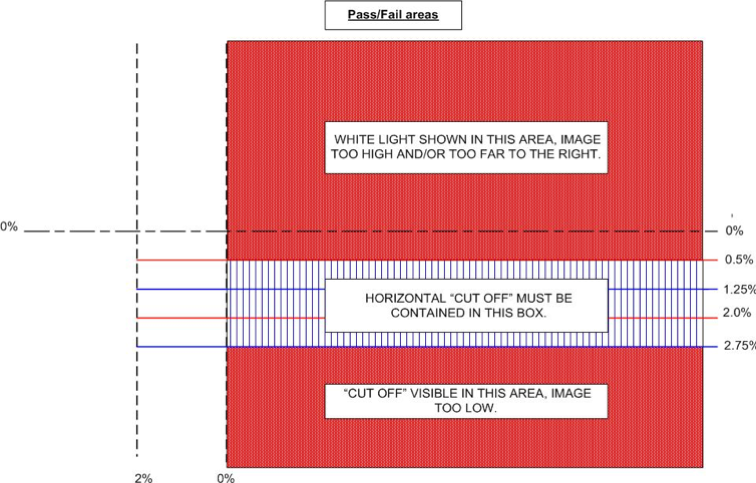
- the beam image horizontal cut-off is between 0.5% and 2.75% below the 0% horizontal line (for headlamps with centres at 850mm or less from the ground)
- the beam image horizontal cut-off is between 1.25% and 2.75% below the 0% horizontal line (for headlamps with centres more than 850mm from the ground)
- white light does not show in the zone formed by the 0% vertical and 0.5% horizontal line
Diagram 1. Criteria for European beam headlamp aim
British American headlamp - check on main beam
Check British American type headlamps on main beam if they have:
- a symmetrical main beam pattern with a central area of maximum intensity (‘hot spot’)
- a circular lens which might be marked with a figure ‘1’ followed by an arrow indicating the direction of dip
You must fail a British American type lamp if its ‘hot spot’ centre is any of the following:
- above the horizontal 0% line
- below the horizontal 2% line (for headlamps with centres at 850mm or less from the ground)
- below the horizontal 2.75% line (for headlamps with centres more than 850mm from the ground)
- to the right of the vertical 0% line
- to the left of the vertical 2% line
For a British American type lamp to pass, you must also make sure the brightest part of the image moves downwards when the lamp is dipped.
Diagram 2. British American headlamp - Main beam image
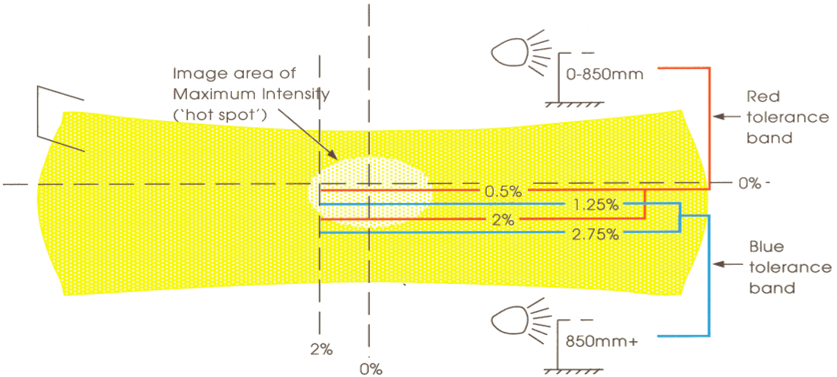
Check the position of the centre of the area of maximum intensity (‘hot spot’)
British American headlamp - check on dipped beam
Check British American headlamps on dipped beam if they have:
- an asymmetric dipped beam pattern which when correctly aimed has a flat-topped area of high intensity extending above and parallel with the horizontal 0% line on the nearside
- a circular lens marked with the figure 2 (it might also have an arrow showing the direction of dip)
You must fail this lamp if the upper edge of the ‘hot spot’ is:
- above the horizontal 0% line
- below the horizontal 2.75% line
You must fail this lamp if the right-hand edge of the ‘hot spot’ is:
- to the right of the vertical 0% line
- to the left of the vertical 2% line
Diagram 3. British American headlamp - Dipped beam image

“Not tested” or “unable to be tested” should only be used where it becomes apparent during the test that the particular item cannot be tested, and this could not have been identified prior to starting the test. The reason for selecting the failure must be included in the additional information box.
| Defect reference |
Defect description |
Category |
| (a) |
The aim of a headlamp is not within limits laid down in the requirements |
Major |
| (b) |
Headlamp aim unable to be tested |
Major |
| (c) |
Beam image obviously incorrect |
Major |
4.1.3. Switching
All headlamps must light up immediately when they’re switched on.
Some motorcycles do not have a headlamp ‘on’ switch and the headlamps light up automatically when the ignition is switched on or the engine is started.
Headlamps must switch immediately between main beam and dipped beam when you operate the dip switch.
On twin headlamp systems one or both headlamps can operate for dipped or main beam.
Operating the dip switch must do one of the following:
- extinguish all main beam headlamps and leave on at least one dipped-beam headlamp
- deflect the main beams to make them dipped beams
Dipped beam headlamps can remain on or switch off when main beam is selected.
Headlamps are not needed on motorcycles first used before 1 January 1931. However, if one is fitted make sure it dips. If 2 are fitted make sure that they do one of the following:
- both headlamps dip
- one headlamp dips and the other headlamp switches off
| Defect reference |
Defect description |
Category |
| (a) |
Headlamp ‘on’ switch does not operate in accordance with the requirements |
Minor |
| (b) |
Headlamp ‘dip’ switch does not operate in accordance with the requirements |
Major |
4.1.4. Compliance with requirements
A motorcycle or motorcycle and sidecar must be fitted with one headlamp, although additional headlamps may be fitted.
Headlamps are not needed on motorcycles that:
- are not fitted with front and rear position lamps
- have had their front and rear position lamps permanently disconnected, painted over or masked
- were first used before 1 January 1931
A motorcycle does not need a main beam headlamp if it:
- was first used before 1 January 1972 and has an engine capacity of less than 50cc
- has a maximum speed up to 30mph or 50km/h
On twin headlamp systems, one or both headlamps may operate on either beam.
The colour of the light that headlamps emit must be one of the following:
- white
- yellow
- mainly white light with a blue tinge
If the light intensity of a mandatory headlamp is significantly reduced, it should be failed.
If the motorcycle does not have a battery or the battery does not have enough charge, you must run the engine to be able to inspect the headlamps.
A ‘light source’ means any bulb, LED or other means of emitting light.
You must assess damaged or repaired lamps for security, colour, light output and durability.
| Defect reference |
Defect description |
Category |
| (a) |
Headlamp emitted colour or intensity not in accordance with the requirements |
Major |
| (b) |
Not in use |
|
4.2. Front and rear position lamps
4.2.1. Presence, condition and operation
All mandatory front and rear position lamps must be inspected.
Position lamps are not testable on motorcycles if they are:
- not fitted or have been removed
- permanently disconnected
- painted over or masked
A solo motorcycle can have one or two front and rear position lamps.
These lamps must be:
- mounted centrally - if there’s one lamp
- mounted one above the other on the centre line - if there’s 2 lamps
- mounted symmetrical about the centre line - if 2 are mounted side by side
Front and rear position lamps can be incorporated with the direction indicator lamps. The position lamp on the same side of the direction indicator may or may not switch off when the indicator is switched on.
A daytime running lamp (DRL) can function as a front position lamp. The DRL may or may not switch off or dim when the headlamps are switched on and the engine is running.
A motorcycle (with or without a sidecar) fitted with a headlamp need not have a front position lamp. However, one must be fitted to the sidecar if a sidecar is fitted.
A motorcycle (with or without a sidecar) must have a rear position lamp. If a sidecar is fitted then the sidecar must be fitted with a rear position lamp.
You must assess damaged or repaired lamps for security, colour, light output and durability.
| Defect reference |
Defect description |
Category |
| (a) |
A lamp missing or inoperative |
Major |
| (b) |
A defective lens |
Major |
| (c)(i) |
A lamp not securely attached |
Minor |
| (c)(ii) |
A lamp likely to become detached |
Major |
4.2.2. Switching
All position lamps must light up simultaneously when switched on.
Front and rear position lamps may be incorporated with the direction indicator lamps. The position lamp on the same side of the direction indicator may or may not switch off when the indicator is switched on.
If a motorcycle has a separate registration plate lamp, it must light up simultaneously with position lamps.
| Defect reference |
Defect description |
Category |
| (a) |
Switch does not operate in accordance with the requirements or the rear position lamps can be switched off when the headlamps are on |
Major |
| (b) |
Switch insecure |
Major |
4.2.3. Compliance with requirements
All lamps
All mandatory front and rear position lamps must be inspected.
You do not need to inspect the precise position of lamps, but you should check visually that the lamps appear to meet the position requirements.
You must assess damaged or repaired lamps for security, colour, light output and durability.
Switch on the position lamps and operate all the other lamps in turn. Check if the position lamps are adversely affected.
Position lamps
A motorcycle fitted with a headlamp does not need to have a front position lamp.
If a motorcycle is fitted with front position lamps, they can emit one of the following:
- white light
- amber light
- mainly white light with a blue tinge
Rear position lamps must be red.
A solo motorcycle can have one or two front and rear position lamps.
A motorcycle and sidecar can be fitted with a yellow headlamp on the motor bicycle and a white front position lamp on the side car.
A sidecar must have a front position lamp.
A motorcycle and sidecar must have:
- 2 front position lamps
- 2 rear position lamps
Front and rear position lamps may be incorporated with the direction indicator lamps. The position lamp on the same side of the direction indicator may or may not switch off when the indicator is switched on.
A headlamp or a daytime running lamp (DRL) can function as a front position lamp. The DRL may or may not switch off or dim when the headlamps are switched on and the engine is running.
| Defect reference |
Defect description |
Category |
| (a)(i) |
Lamp emitted colour, position or intensity not in accordance with the requirements |
Minor |
| (a)(ii) |
Lamp showing red light to the front, white light to the rear or has heavily reduced light intensity |
Major |
| (b) |
Lamp adversely affected by the operation of any other lamp |
Major |
4.3. Stop lamps
4.3.1. Presence, condition and operation
All stop lamps must be inspected. If you do not think the stop lamp is connected, you do not need to test it.
Stop lamps are not needed for motorcycles that:
- do not have front and rear position lamps
- have had front and rear position lamps permanently disconnected, painted over or masked
- cannot exceed 25mph
- was first used before 1 January 1936
- was first used before 1 April 1986 and has an engine capacity of less than 50cc
Motorcycles, with or without a sidecar, can have one or two stop lamps.
Additional stop lamps, over and above the requirements, must be tested. However, if you are not certain that they are connected, you should give the benefit of this doubt.
If a motorcycle does not have a battery or the battery does not have enough charge, you must run the engine to be able to inspect the stop lamps.
A ‘light source’ means any bulb, LED or other means of emitting light.
You must assess damaged or repaired lamps for security, colour, light output and durability.
| Defect reference |
Defect description |
Category |
| (a)(i) |
Stop lamps with a multiple light source up to 1/2 not functioning |
Minor |
| (a)(ii) |
Stop lamps missing, inoperative or in the case of a multiple light source more than 1/2 not functioning |
Major |
| (a)(iii) |
Stop lamps all missing or inoperative |
Dangerous |
| (b)(i) |
A lens defective which has no effect on emitted light |
Minor |
| (b)(ii) |
A lens defective such that the emitted light is adversely affected |
Major |
| (c)(i) |
A stop lamp not securely attached |
Minor |
| (c)(ii) |
A stop lamp likely to become detached |
Major |
4.3.2. Switching
Motorcycles first used on or after 1 April 1986 must have a stop lamp that switch on from both brake controls. However, a small number of motorcycles first used from this date were approved with the stop lamp switching on by only one control. You should fail the stop lamp only if you are certain that it was originally manufactured to switch on from both controls.
All stop lamps should light up immediately when the brake is applied and switch off immediately the brake is released.
Additional stop lamps, over and above the mandatory requirements, must be tested. However, if there is doubt as to whether they are connected, the benefit of this doubt should be given.
| Defect reference |
Defect description |
Category |
| (a)(i) |
A stop lamps switch does not operate in accordance with the requirements |
Minor |
| (a)(ii) |
A stop lamps switch with a delay in operation |
Major |
| (a)(iii) |
A stop lamps does not illuminate by the operation of both brake controls or remains on when the brakes are released |
Dangerous |
4.3.3. Compliance with requirements
You must test all stop lamps.
Stop lamps are not needed on motorcycles that:
- do not have front and rear position lamps
- have front and rear position lamps permanently disconnected, painted over or masked
Solo motorcycles and a motorcycle and sidecar need to have only one stop lamp.
The stop lamp should be mounted on the centre line or to the offside of the motorcycle, disregarding any sidecar fitted.
Additional stop lamps, over and above the mandatory requirements, must be tested. However, if you are not certain that they are connected, you should give the benefit of the doubt.
Stop lamps must emit a steady red light.
You must assess damaged or repaired lamps for security, colour, light output and durability.
Switch on the stop lamps and operate all the other lamps in turn to see if the stop lamps are adversely affected.
| Defect reference |
Defect description |
Category |
| (a)(i) |
A stop lamp position or intensity not in accordance with the requirements |
Minor |
| (a)(ii) |
A stop lamp not showing a steady red light or has significantly reduced light intensity |
Major |
| (b) |
A stop lamp adversely affected by the operation of any other lamp |
Major |
4.4. Direction indicators
4.4.1. Presence, condition and operation
You must inspect all direction indicators.
Direction indicators are not needed for motorcycles that:
- do not have front and rear position lamps
- have front and rear position lamps permanently disconnected, painted over or masked
- cannot exceed 30mph / 50kph
- was first used before 1 August 1986
- are ‘off road’ motorcycles designed to carry only the rider
- are ‘off road’ motorcycle and sidecar designed to carry the rider and one passenger in the sidecar
‘Off road’ motorcycles are constructed or adapted primarily for use off road. For example, their tyres, suspension or ground clearance have been adapted for off road use.
Direction indicators must emit amber light, except motorcycles first used before 1 September 1965 can have white front indicators and red rear indicators.
A ‘light source’ means any bulb, LED or other means of emitting light.
You must assess damaged or repaired lamps for security, colour, light output and durability.
Direction indicators that function sequentially/dynamically are not to be considered a reason to fail.
| Defect reference |
Defect description |
Category |
| (a)(i) |
A direction indicator lamp with a multiple light source up to 1/2 not functioning |
Minor |
| (a)(ii) |
A direction indicator lamp missing, inoperative or in the case of a multiple light source more than 1/2 not functioning |
Major |
| (b)(i) |
A lens defective which has no effect on emitted light |
Minor |
| (b)(ii) |
A lens defective such that the emitted light is adversely affected |
Major |
| (c)(i) |
A lamp not securely attached |
Minor |
| (c)(ii) |
A lamp likely to become detached |
Major |
4.4.2. Switching
Check that the director indicator switch is secure, can be used from the normal riding position, and works as intended.
| Defect reference |
Defect description |
Category |
| (a)(i) |
Indicator switch does not operate in accordance with the requirements |
Minor |
| (a)(ii) |
Indicator switch inoperative |
Major |
4.4.3. Compliance with requirements
You must inspect all direction indicators fitted.
Direction indicators must emit an amber light, except motorcycles first used before 1 September 1965 can have white front indicators and red rear indicators.
Switch on the direction indicators and operate all the other lamps in turn to see if the direction indicators are adversely affected.
The position lamp on the same side of the direction indicator may or may not switch off when the indicator is switched on.
Some motorcycles have direction indicators combined with the position lamps. In these cases the position lamp does not have to switch off when the relevant direction indicator is switched on.
The precise position of direction indicators are not part of this inspection, but they must be on each side of the longitudinal axis of a solo machine. If a sidecar is attached, the indicators must be on opposite sides of the combination.
Mandatory direction indicators must have minimum separation distances between the illuminating surfaces of:
- mopeds (Category L1) - 240mm at the front and 160mm at the rear
- solo motorcycles - 240mm at the front and 180mm at the rear
- motorcycle and sidecar - 400mm at both front and rear
There is no requirement to measure the separation distance and they should only be rejected if the separation distance is obviously incorrect.
You must assess damaged or repaired lamps for security, colour, light output and durability.
Direction indicators that function sequentially/dynamically are not to be considered a reason to fail.
| Defect reference |
Defect description |
Category |
| (a) |
Lamp emitted colour, position or intensity not in accordance with the requirements |
Major |
| (b) |
A direction indicator lamp adversely affected by the operation of any other lamp |
Major |
4.4.4. Flashing frequency
Indicators must flash between 60 and 120 times per minute.
| Defect reference |
Defect description |
Category |
| (a) |
Rate of flashing not between 60 and 120 times per minute |
Minor |
4.7. Rear registration plate lamp
4.7.1. Presence, condition and operation
You must inspect all motorcycles fitted with front and rear position lamps.
The rear registration plate must be lit. Most motorcycles will light the registration plate with a rear position lamp, but some will use a separate registration plate lamp.
Some registration plate lamps may be fitted behind the number plate.
Some mopeds might not have a registration plate lamp.
| Defect reference |
Defect description |
Category |
| (a) |
A rear registration plate lamp throwing direct white light to the rear |
Minor |
| (b)(i) |
A rear registration plate lamp or light source missing or inoperative when rear registration plate has 2 or more lamps or light sources |
Minor |
| (b)(ii) |
A rear registration plate lamp or light source missing or inoperative when rear registration plate has only one lamp or all lamps not working |
Major |
| (c)(i) |
A registration plate lamp not securely attached |
Minor |
| (c)(ii) |
A registration plate lamp likely to become detached |
Major |
4.7.2. Compliance with requirements
You must inspect all motorcycles fitted with front and rear position lamps.
Registration plate lamps must switch on at the same time with the position lamps.
| Defect |
Category |
| (a) Rear registration plate lamp does not illuminate simultaneously with the position lamps |
Major |
4.8. Rear reflectors
4.8.1. Presence, condition and operation
You must only inspect the one mandatory rear reflector on a solo machine, or 2 on a motorcycle combination.
Motorcycles must have one red reflector aligned to the longitudinal centre line and positioned to reflect squarely to the rear. On motorcycle and sidecar, the sidecar must also have a reflector fitted towards the outer side and positioned to reflect squarely to the rear.
Rear reflectors are not needed on motorcycles that:
- do not have front and rear position lamps fitted
- have such lamps permanently disconnected, painted over or masked
Reflective tape is not an acceptable substitute for a rear reflector.
| Defect reference |
Defect description |
Category |
| (a)(i) |
Reflector defective or damaged by up to 50% of the reflecting surface |
Minor |
| (a)(ii) |
Reflector defective or damaged by more than 50% of the reflecting surface |
Major |
| (b)(i) |
Reflector not securely attached |
Minor |
| (b)(ii) |
Reflector likely to become detached |
Major |
4.8.2. Compliance with requirements
You must inspect mandatory rear reflectors.
Motorcycles must have one red reflector aligned to the longitudinal centre line and positioned to reflect squarely to the rear. On motorcycle and sidecar, the sidecar must have a reflector fitted towards the outer side and positioned to reflect squarely to the rear.
Rear reflectors are not needed on motorcycles without front and rear position lamps or have such lamps permanently disconnected, painted over or masked.
Reflective tape is not an acceptable substitute for a rear reflector.
| Defect reference |
Defect description |
Category |
| (a)(i) |
Reflector colour or position not in accordance with the requirements |
Minor |
| (a)(ii) |
Reflector missing or reflecting white to the rear |
Major |
4.9. Direction indicator tell-tale
4.9.1. Condition and operation
You must inspect motorcycles fitted with direction indicators.
A tell-tale is not needed if a direction indicator on each side of the motorcycle can be seen from the riding position.
A direction indicator tell-tale can be audible or visual.
| Defect reference |
Defect description |
Category |
| (a)(i) |
A mandatory direction indicator tell-tale missing or inoperative |
Minor |
Section 5
Wheels, tyres and suspension
Wheel bearing, wheel and tyre, and suspension (including springs, shock absorbers, and suspension arms and joints) rules and inspection for motorcycle MOT tests.
5.1. Wheel bearings
5.1.1. Not in use
5.1.2. Not in use
5.1.3. Wheel bearings
To assess the wheel bearings:
-
With each wheel raised clear of the ground, including any sidecar wheel, rock the wheel by hand to check for excessive play in the wheel bearings.
-
Spin the wheel and listen for roughness in the bearings.
| Defect reference |
Defect description |
Category |
| (a)(i) |
A wheel bearing with excessive play |
Major |
| (a)(ii) |
A wheel bearing play so excessive it is likely to break up or directional control impaired |
Dangerous |
| (b)(i) |
A wheel bearing excessively rough |
Major |
| (b)(ii) |
A wheel bearing so rough it is likely to overheat or break up |
Dangerous |
5.2. Wheels and tyres
5.2.1. Road wheel security
Check that each wheel, including any sidecar wheel and its associated fixings are present and secure.
Also check the condition of each wheel hub.
| Defect reference |
Defect description |
Category |
| (a)(i) |
A wheel with a loose or missing wheel nut, bolt or stud in the case of multiple fixings |
Major |
| (a)(ii) |
A wheel with a loose or missing wheel nut, bolt or stud in the case of a single fixing, or more than one loose or missing in the case of multiple fixings |
Dangerous |
| (b)(i) |
A wheel hub excessively worn or damaged |
Major |
| (b)(ii) |
A wheel hub worn or damaged to the extent that wheel security is adversely affected |
Dangerous |
| (c)(i) |
A wheel spindle loose |
Major |
| (c)(ii) |
A wheel spindle a wheel spindle or its securing nut(s) so insecure that wheel security or steering control is adversely affected |
Dangerous |
| (d) |
A wheel spindle locking device missing or ineffective |
Major |
5.2.2. Road wheel condition
Check the roadwheels fitted to the motorcycle and any sidecar.
Spare wheels are not included in the inspection, but you should tell the presenter if you notice a defect.
The maximum lateral rim distortion (run out or buckling) limits are:
- 4mm for steel rims
- 2mm for aluminium alloy rims (cast or fabricated)
The maximum eccentricity is 3mm for all types of rim.
Measurements should be taken from a machined surface in the case of cast aluminium alloy rims.
| Defect reference |
Defect description |
Category |
| (a) |
Any fracture or welding defect on a wheel |
Dangerous |
| (b) |
Not in use |
|
| (c)(i) |
A wheel excessively corroded, damaged or distorted |
Major |
| (c)(ii) |
A wheel corroded, damaged or distorted to the extent that control of the motorcycle is likely to be adversely affected |
Dangerous |
| (d) |
A spoke missing, cracked, excessively loose, bent or corroded |
Major |
| (e)(i) |
A built-up wheel with loose or missing rivets or bolts |
Major |
| (e)(ii) |
A built-up wheel with rivets or bolts missing or loose to the extent that control of the motorcycle is likely to be adversely affected |
Dangerous |
5.2.3. Tyres
Spare tyres are not included in the inspection, but you should tell the presenter if you notice a defect.
Size and type
The aspect ratio of a tyre is included in the size marking. For example, a 170/55R17 has an aspect ratio of 55%.
On motorcycles with twin front or rear wheels, check that each tyre on the ‘axle’ is the same size and structure.
Examples of an unsuitable tyre are:
- a sidecar or car tyre on a solo motorcycle - sidecars may be fitted with either car or motorcycle type tyres
- a tyre specifically designed for front wheel use fitted to the rear wheel
- a bias belted tyre fitted to the front with a cross-ply tyre fitted to the rear
- a radial tyre fitted to the front and a cross-ply or bias belted tyre fitted to the rear.
Additionally, motocross tyres, tyres designated by their manufacturer as racing tyres and tyres marked ‘NHS’ or ‘NOT FOR HIGHWAY USE’ on the sidewall are also unsuitable, unless the tyre sidewall is marked with:
- an ‘E’ in a circle
- an ‘e’ in a rectangle
- JIS (Japanese industry standard)
- DOT (American standard)
Motocross tyres are deemed to be those where the space between tread blocks is substantially greater than the size of the blocks themselves.
Directional tyres must be fitted as instructed on the sidewall. They may use arrow and/or words to indicate the direction of forward rotation.
Condition and fitment
You must reject a tyre if:
- it’s damaged to the extent that the ply or cord is exposed
- it has a lump, bulge or tear caused by separation or partial failure of its structure
- the tread rubber is lifting
On a radial ply tyre, you should take care to distinguish between normal undulations in the carcass, resulting from manufacturing, and lumps or bulges caused by structural deterioration.
When assessing cuts in a tyre, you can use a blunt instrument to open a cut to check whether the cut is deep enough to reach the ply or cord. You should take care not to cause further damage.
When assessing a cut in a tyre, you must reject the tyre if:
- ply or cord can be seen without touching the tyre
- exposed ply or cord can be seen - irrespective of the size of the cut - by folding back rubber or opening a cut with a blunt instrument
- cords can be felt but not seen when a cut more than 25mm or 10% of the section width - whichever is the greater - is opened with a blunt instrument
Before failing a tyre due to being able to feel the cords in a cut, you must ensure that you can feel the cords and not some other object. If you are not sure, then you should pass and advise.
Loose or missing tyre security bolts are not a defect, if you notice them you should tell the presenter.
Tread depth
A tread pattern is the combination of plain surfaces and grooves extending across the breadth of the tread and around the entire circumference. It excludes any tie-bars, tread wear indicators, or features designed to wear out substantially before the remainder of the pattern, and other minor features.
Grooves containing tread wear indicators (TWI) or grooves cut as deep as those containing the wear indicators when new, are considered to be primary grooves. Other grooves or sipes that are not cut as deep as the primary grooves are secondary grooves and do not need to be considered when assessing tread depth.
The ‘breadth of tread’ is the part of the tyre which can contact the road under normal use, including cornering.
The tread pattern must:
- be visible over the whole tread area
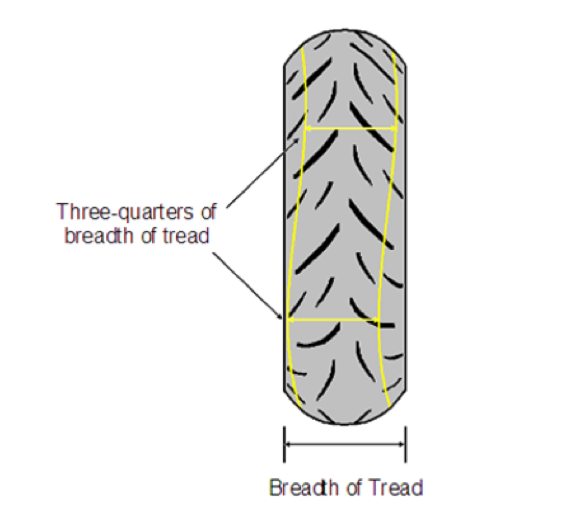
- have a depth of at least 1.0mm throughout a single band of at least 3/4 over any section of the breadth of tread round the entire outer tyre circumference
The whole tread width must have at least 1.0mm deep tread if the original tread pattern did not extend beyond 3/4 of the tyre width when new.
The continuous band of 1mm tread depth over 3/4 of the breadth of tread does not have to run parallel to the tyre centre line (see Diagram 1).
Motorcycles with an engine capacity not greater than 50cc do not need to have 1mm of tread. However, they must have a visible tread pattern around the entire circumference and across the whole breadth of the tread.
Diagram 1. Example of tyre tread area, depth and width
| Defect reference |
Defect description |
Category |
| (a) |
An unsuitable tyre fitted |
Major |
| (b) |
Tyres on twin wheels are different sizes |
Major |
| (c) |
Tyres on twin wheels of different structure |
Major |
| (d)(i) |
A tyre with a cut in excess of the requirements deep enough to reach the ply or cords |
Major |
| (d)(ii) |
A tyre with a lump, bulge or tear caused by separation or partial failure of its structure, including any lifting of the tread rubber or with cords exposed or damaged |
Dangerous |
| (e) |
Tyre tread depth not in accordance with the requirements |
Dangerous |
| (f) |
A tyre fouling another component |
Major |
| (g) |
A tyre with a recut tread fitted |
Major |
| (h) |
Not in use |
|
| (i) |
A tyre not fitted in compliance with the manufacturer’s sidewall instructions |
Major |
| (j) |
A tyre valve seriously damaged or misaligned likely to cause sudden deflation of the tyre |
Dangerous |
| (k) |
A tyre incorrectly seated on the wheel rim |
Major |
5.3. Suspension
5.3.1. Springs
Some motorcycles are not fitted with rear suspension.
Unsafe modifications include:
- welded repairs
- the use of excessive heat to highly stressed components (see Appendix A)
- modifications likely to affect the roadworthiness of the motorcycle
| Defect reference |
Defect description |
Category |
| (a)(i) |
A spring insecurely attached |
Major |
| (a)(ii) |
A spring so insecure that control of the motorcycle is likely to be adversely affected |
Dangerous |
| (b)(i) |
A spring or spring component fractured or seriously weakened |
Major |
| (b)(ii) |
A spring main leaf fractured |
Dangerous |
| (c)(i) |
A spring missing |
Major |
| (c)(ii) |
A spring missing and control of the motorcycle is likely to be adversely affected |
Dangerous |
| (d) |
A spring with an unsafe modification |
Major |
5.3.2. Shock absorbers
A missing shock absorber should only be rejected if they were fitted as standard.
On most motorcycles front shock absorbers will be incorporated into front forks.
Some smaller motorcycles are not fitted with shock absorbers on the front suspension.
If twin shock absorbers are fitted and they do not seem to be equally adjusted, you should inform the presenter.
On motorcycles with anti-dive front suspension which restricts front suspension movement when the brake is applied, it may be necessary to place the front wheel against a wall when checking the effectiveness of the shock absorber(s).
Light misting on a suspension shock absorber causing thin film of fluid is not considered a defect.
Rubber fork gaiters may be pulled back to assess oil leakage from a shock absorber if it’s possible to do without dismantling or damage. You must make sure to refit them correctly.
| Defect reference |
Defect description |
Category |
| (a)(i) |
A shock absorber insecurely attached |
Major |
| (a)(ii) |
A shock absorber missing or likely to become detached |
Dangerous |
| (b) |
A shock absorber not functioning or leaking severely |
Major |
| (c) |
A shock absorber bush excessively worn |
Major |
5.3.3. Suspension arms, rods, linkage etc.
Some motorcycles are not fitted with rear suspension.
To fully access rear suspension components it may be necessary to remove side panels or the seat to carry out a full examination.
With mono-shock type suspension some linkage movement may be observed when the rear suspension is ‘hanging’.
On machines without a centre stand, suitable equipment must be used to raise the wheels clear of the ground, either independently or simultaneously, using an assistant where necessary. Pulling a motorcycle over on its side-stand is not recommended.
The machine should be jacked so that the wheels are hanging free.
Some fork arrangements rely on the bracing incorporated in the mudguard fixings to maintain their alignment. If a mudguard is insecurely fixed to the forks, it may adversely affect the handling of the machine.
Unsafe modifications include:
- welded repairs
- the use of excessive heat to highly stressed components (see Appendix A)
- modifications likely to affect the roadworthiness of the motorcycle
Guidance on assessing corrosion is given in Appendix A
| Defect reference |
Defect description |
Category |
| (a)(i) |
A suspension component insecurely attached |
Major |
| (a)(ii) |
A suspension component missing, likely to become detached or control of the motorcycle impaired |
Dangerous |
| (b)(i) |
A suspension component excessively damaged or corroded |
Major |
| (b)(ii) |
A suspension component fractured or likely to fail |
Dangerous |
| (c)(i) |
A suspension component with an unsafe modification |
Major |
| (c)(ii) |
A suspension component modified so that the suspension is inoperative or likely to foul other components |
Dangerous |
| (d) |
Excessive wear or free play in a suspension component |
Major |
5.3.4. Suspension joints, pins and bushes
Some motorcycles are not fitted with rear suspension.
To fully access rear suspension components it may be necessary to remove side panels or the seat to carry out a full examination.
With mono-shock type suspension some linkage movement may be observed when the suspension is in an abnormal position.
The condition of suspension pins, bushes, mountings and ball joints should be checked by attempting to move the suspension from side to side and up and down with the wheels raised and resting on hardstanding.
| Defect reference |
Defect description |
Category |
| (a)(i) |
A suspension pin, bush or joint excessively worn |
Major |
| (a)(ii) |
A suspension pin, bush or joint likely to become detached |
Dangerous |
| (b)(i) |
A suspension joint dust cover severely deteriorated |
Minor |
| (b)(ii) |
A suspension joint dust cover missing or no longer prevents the ingress of dirt etc. |
Major |
Appendix A
Structural integrity and corrosion
Assessing corrosion and methods of repair for motorcycle MOT tests.
1. Introduction
The effect of corrosion on the safety of a motorcycle is a difficult matter to resolve since it depends not only on the extent of the corrosion but also on the function of the section where corrosion is found.
A small amount of corrosion which substantially weakens an important component or part of the structure would make the motorcycle unsafe, whilst significant corrosion of a less important part may be acceptable.
2. Corrosion assessment
You should identify the important load bearing members and highly stressed parts of the motorcycle such as the frame, suspension components and reaction brackets. Then determine whether any of these parts are excessively corroded, firstly by visual inspection and then by applying pressure with finger and thumb.
If necessary, the corrosion assessment tool should be used to assess the extent of any corrosion by carefully scraping or lightly tapping the affected areas.
The corrosion assessment tool should be only used to ensure that the failure criteria are met, and not for poking or heavily scraping the corroded areas.
Excessively corroded metal, or metal treated with filler, emits a duller sound than unaffected metal. You must not hit or use a sharp instrument to probe at the frame or components.
3. Failure criteria
After determining the extent of the corrosion, you must use your experience to judge whether the degree or position of the corrosion has significantly affected the strength of the part, considering remaining amount of sound metal.
You must consider if the corrosion is likely to make the motorcycle dangerous to use on the road under any condition of use, such as fast cornering, use on uneven ground and emergency braking.
Structural corrosion should not be regarded as defective if you consider the motorcycle safe to use. However, you should advise the owner of the presence and location of the corrosion.
If the corrosion has severely reduced the strength of a certain component, you can refuse to carry out a brake test. See ‘Refusal to test’ in Introduction.
4. Highly stressed components
The severity of general or local corrosion in highly stressed components, such as suspension arms, rods and levers can be assessed by lightly tapping or scraping with the Corrosion Assessment Tool.
In places inaccessible to the Corrosion Assessment Tool, an alternative blunt instrument may be used. A highly stressed component should be rejected if corrosion has resulted in serious reduction in the overall thickness of the material, or has caused a hole or split.
Welded repairs to highly stressed components are not normally acceptable, other than where the component is made up of sections that are welded together. In these cases the repair should appear to be as strong as the original design.
5. Acceptable methods of repair
It’s essential that repairs to structural components are properly carried out and appear to be as strong as the original structure. Suitable materials of appropriate gauge or thickness must be used and any plating or welding extends to a sound part of a load bearing member.
6. Unacceptable methods of repair
Gas brazing, soldering, adhesive bonding, fibre reinforcement and body filler are bonding processes and are not regarded as strong enough for repairs to load bearing members, although they are normally adequate for other repair work.
Brazing, bonding and riveting are only acceptable when used by the motorcycle manufacturer. The standard of any such repair must be comparable to the original strength of the component.
Sometimes it’s difficult to identify the repair method, especially after the repair has been covered in paint or underseal. If you are not sure what the method of repair is, you should pass and advise.
8. Component replacement made of different materials
If a component has been replaced with one made from a different material, you should consider whether the replacement component is strong and stiff enough to perform its intended function.
If you are not sure about the effect of the modification, you should pass and advise.